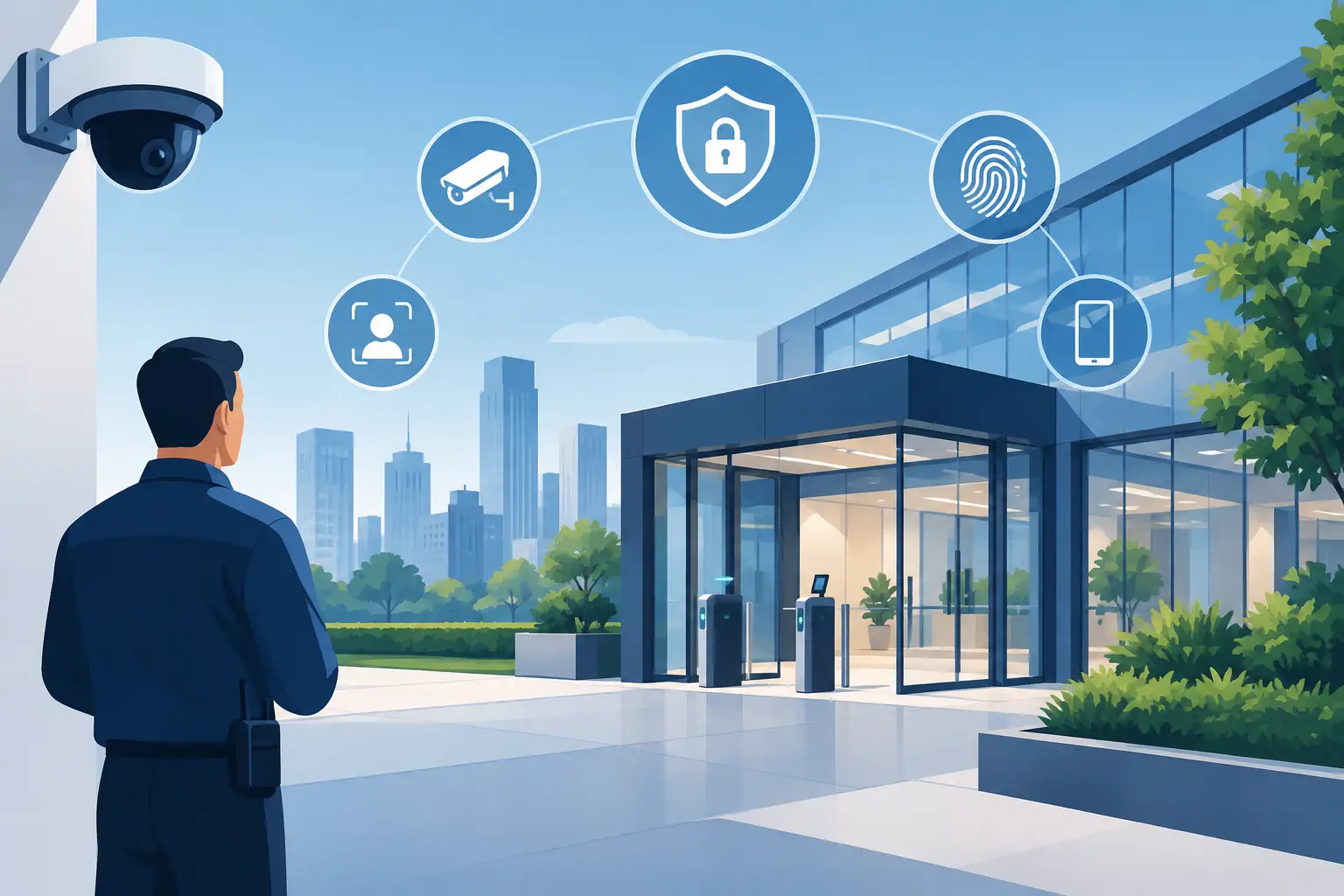
A security issue rarely starts with a dramatic breach. More often, it starts with a door that does not latch, a delivery entrance that stays propped open, a parking lot with poor visibility, or a contractor policy that no one has reviewed in years. That is why a sound physical risk assessment methodology matters. It gives decision-makers a disciplined way to identify where exposure exists, how likely it is to be exploited, and what level of protection makes operational and financial sense.
For business owners, property managers, operations leaders, and event planners, the goal is not to create a thicker binder of security paperwork. The goal is to reduce the chance of disruption while keeping the site functional for employees, tenants, guests, and vendors. A good assessment should support business continuity, not interfere with it.
What a physical risk assessment methodology should actually do
At its core, a physical risk assessment methodology is a structured process for evaluating threats, vulnerabilities, existing safeguards, and likely consequences. It helps an organization answer four practical questions: what needs protection, what could happen, where are the weak points, and what should be fixed first.
That sounds straightforward, but the quality of the method matters. A weak assessment tends to be either too generic or too alarmist. Generic assessments miss site-specific realities such as shift changes, public access points, after-hours traffic, or the behavior patterns of tenants and visitors. Alarmist assessments recommend controls that may look impressive on paper but add cost, friction, and little real reduction in risk.
An effective methodology stays grounded in the way the property or operation actually runs. A distribution site, medical office, office tower, school event, and financial institution do not face the same physical risks, and they should not be assessed with the same assumptions.
Start with assets, not gadgets
Security planning often goes off track when the conversation starts with equipment. Cameras, gates, card readers, and guards all have a place, but they are not the starting point. The first step is to define what is being protected.
That usually includes people, facilities, inventory, cash or high-value assets, brand reputation, and the ability to continue operating. In some environments, life safety is the primary concern. In others, the priority may be preventing theft, controlling access, protecting sensitive areas, or ensuring an event runs without interruption. Most organizations are balancing several of these at once.
This is where leadership input matters. The same incident can have very different consequences depending on the business. A broken fence line may be a moderate issue for one property and a serious exposure for another. If the site stores regulated materials, supports critical operations, or has public-facing liability concerns, the impact changes quickly.
Threat identification has to be local and realistic
The next stage in a physical risk assessment methodology is identifying relevant threats. That includes criminal activity such as theft, burglary, vandalism, trespassing, assault, workplace violence, and organized targeting. It also includes operational and environmental concerns such as unauthorized access, tailgating, parking lot incidents, protest activity, severe weather exposure, and emergency evacuation challenges.
This part should never rely on assumptions alone. Local crime patterns, recent incidents on site, neighborhood conditions, business hours, staffing levels, and nearby facilities all affect the risk picture. A property that appears low-risk during the day may face a very different threat profile overnight. An event venue with controlled ticketing may still be vulnerable at secondary entrances, loading zones, or parking areas.
Realism is essential here. If every theoretical threat is treated as equally urgent, the assessment loses value. If likely threats are minimized because there has not been a recent incident, that creates false confidence. The right balance comes from field observation, operating history, and experience with similar sites.
Vulnerability assessment is where the real work happens
Once threats are identified, the assessment turns to vulnerabilities. This is where security professionals examine how an incident could occur or worsen.
Physical vulnerabilities often include weak perimeter controls, inadequate lighting, blind spots in camera coverage, unsecured access points, poor key control, inconsistent visitor procedures, limited guard visibility, and barriers that do not match the level of exposure. Just as important are procedural gaps. A facility may have good hardware but weak enforcement, outdated emergency procedures, or inconsistent response expectations across shifts.
Human behavior is part of vulnerability assessment as well. Employees who prop doors, contractors who bypass sign-in rules, or event staff who are unclear on escalation protocols can undermine otherwise solid controls. In many cases, the issue is not that a site has no security measures. It is that those measures are uneven, outdated, or not aligned with current operations.
Ranking risk requires context, not guesswork
A useful assessment does more than describe problems. It prioritizes them.
Most physical risk assessment methodology models rate risk by looking at the likelihood of an incident and the consequence if it occurs. That is a sound approach, but the scoring has to be tied to the client environment. A low-frequency event with catastrophic impact may deserve immediate attention. A frequent nuisance issue may warrant action too, especially if it affects safety, employee confidence, tenant satisfaction, or liability exposure.
This is also where trade-offs come into view. The highest level of control is not always the right answer. Adding stricter access barriers may improve security but slow logistics. Increasing visible officer presence may deter misconduct but change the customer experience. Locking down a site after hours may reduce intrusion risk but complicate cleaning, maintenance, or vendor access. Strong recommendations account for these operational realities.
A strong methodology examines current controls honestly
Some assessments make the mistake of listing controls without testing whether they are effective. A camera is only useful if it captures usable footage, covers the right area, and supports response. An access control system only works if permissions are current and door events are reviewed. An on-site officer presence only reduces risk when post orders are clear, patrol patterns are appropriate, and escalation procedures are understood.
That is why current controls should be evaluated for coverage, condition, consistency, and response value. In practical terms, the question is not whether a measure exists. The question is whether it meaningfully reduces exposure.
For many clients, this is where outside perspective helps. Internal teams can become accustomed to workarounds that no longer make sense. A disciplined review can identify blind spots without overcomplicating the operation. That service-led approach is a major reason organizations engage firms such as Springfield Private Security when risk exposure affects safety, continuity, and liability.
Recommendations should be phased and practical
The final output of a physical risk assessment methodology should be a clear action plan. Not every recommendation needs to happen at once.
In most cases, the best path is phased improvement. Immediate corrective actions address urgent gaps such as broken locks, failed lighting, uncontrolled access points, or missing incident procedures. Mid-range improvements may include revised post orders, better visitor management, patrol adjustments, staff training, or targeted technology upgrades. Longer-term planning may involve redesigning traffic flow, strengthening perimeter design, or standardizing security practices across multiple sites.
This phased approach matters because budgets, staffing, and operational constraints are real. An assessment has to be actionable within the client’s environment. If recommendations are too broad or too expensive to execute, they often sit untouched. If they are prioritized correctly, even modest changes can reduce risk quickly.
Why methodology matters for multi-site operations and events
Single-location facilities benefit from tailored assessments, but methodology becomes even more important when an organization manages multiple sites or recurring events. Without a consistent method, one location may have strong controls while another operates with preventable gaps. That inconsistency increases liability and makes incident response harder to coordinate.
A standardized assessment framework creates comparable data across properties while still allowing for site-specific differences. That is especially useful for retail portfolios, office properties, industrial operations, schools, healthcare facilities, and regional event programs. It helps leadership see where resources should be concentrated and where policies need to be tightened.
For events, the timeline is compressed, which raises the value of a disciplined method even more. Entry points, crowd movement, VIP exposure, vehicle access, medical coordination, and emergency communication all need to be reviewed before the first guest arrives. A rushed walk-through is not enough.
What decision-makers should expect from the process
A professional assessment should leave you with more than a risk score. It should give you a clearer picture of how your site functions under normal conditions, where disruption is most likely to occur, and what changes will produce measurable improvement.
You should expect direct observations, not canned language. You should expect recommendations tied to your hours, traffic patterns, tenant mix, staffing realities, and business goals. And you should expect candid guidance on what requires immediate attention versus what can be improved over time.
The best methodology is not the one with the most complicated scoring matrix. It is the one that helps you make better decisions, reduce avoidable exposure, and keep operations moving with confidence. If your current security plan cannot do that, the next step is not more paperwork. It is a clearer assessment of what your environment actually demands.