
A shattered storefront window at 3:00 a.m. raises one question fast: was this a property crime, or the start of a bigger threat to people on site? That is usually when should businesses use armed guards becomes more than a general security topic. It becomes an operational decision tied to risk, liability, and response time.
For most organizations, armed security is not a default setting. It is a measured response to specific conditions: elevated threat exposure, valuable assets, known criminal targeting, public-facing operations with volatility, or environments where a visible deterrent and immediate defensive capability are justified. The right answer depends on what your site faces day to day, how quickly law enforcement can realistically respond, and whether unarmed coverage leaves a gap you cannot accept.
When should businesses use armed guards as a practical decision?
Businesses should use armed guards when the threat profile includes a credible risk of violent confrontation, not just theft or trespassing. That distinction matters. Many sites need access control, patrol, de-escalation, and reporting. Fewer need an officer who is trained, licensed, and equipped to respond to an armed threat.
A good starting point is to look at three factors together: the likelihood of violence, the potential consequences if violence occurs, and the time it would take for outside responders to intervene. If the likelihood is low and the consequences are manageable, unarmed officers, cameras, lighting, and procedural controls may be enough. If the likelihood is meaningful and the downside includes injury, hostage risk, severe business interruption, or high-value loss, armed security may be warranted.
This is why the decision should not be based on appearance alone. Some businesses want a stronger security presence because it feels reassuring. That may be understandable, but armed coverage should be tied to documented needs, not optics. The wrong fit can create unnecessary cost, increase tension in customer-facing environments, and introduce additional liability if the program is not properly managed.
High-risk conditions that often justify armed guards
Certain environments tend to support a stronger case for armed coverage because the threat level is structurally higher. Financial institutions are an obvious example. Banks, armored cash activity, and sites handling large volumes of cash or negotiable assets face a different risk category than standard office buildings.
Cannabis facilities, pharmacies, jewelry stores, data centers, and critical infrastructure sites often fall into a similar category for different reasons. Some hold high-value inventory. Others support operations that cannot tolerate disruption. In these settings, the question is not only whether theft may occur, but whether organized, force-based attempts are plausible.
Late-night businesses can also face elevated exposure, especially in locations with repeated criminal activity, prior assaults, or frequent disturbances. Convenience stores, hotels, bars, transportation hubs, and some logistics facilities may see situations where an unarmed presence can observe and report but cannot close the response gap if a weapon is introduced.
Executive protection assignments, high-profile events, labor disputes, terminations with known threat indicators, and facilities subject to targeted harassment also deserve close review. These are not routine guarding scenarios. They involve a higher probability of emotional escalation, reputational impact, or direct threats against named individuals.
When should businesses use armed guards instead of unarmed officers?
The difference is not simply whether one officer carries a firearm and the other does not. It is about mission fit.
Unarmed officers are often the better choice for customer service-heavy properties, corporate offices, residential communities, schools with low threat exposure, and commercial sites where the core need is access control, policy enforcement, visibility, and incident reporting. In many cases, they reduce risk effectively without changing the tone of the environment.
Armed officers become more appropriate when a site needs a credible response to a deadly threat, not just a witness presence. If officers may need to protect staff during a robbery, secure high-risk transport activity, stand post where violent crime is a documented concern, or cover an event with elevated threat indicators, then armed coverage may be the right operational tool.
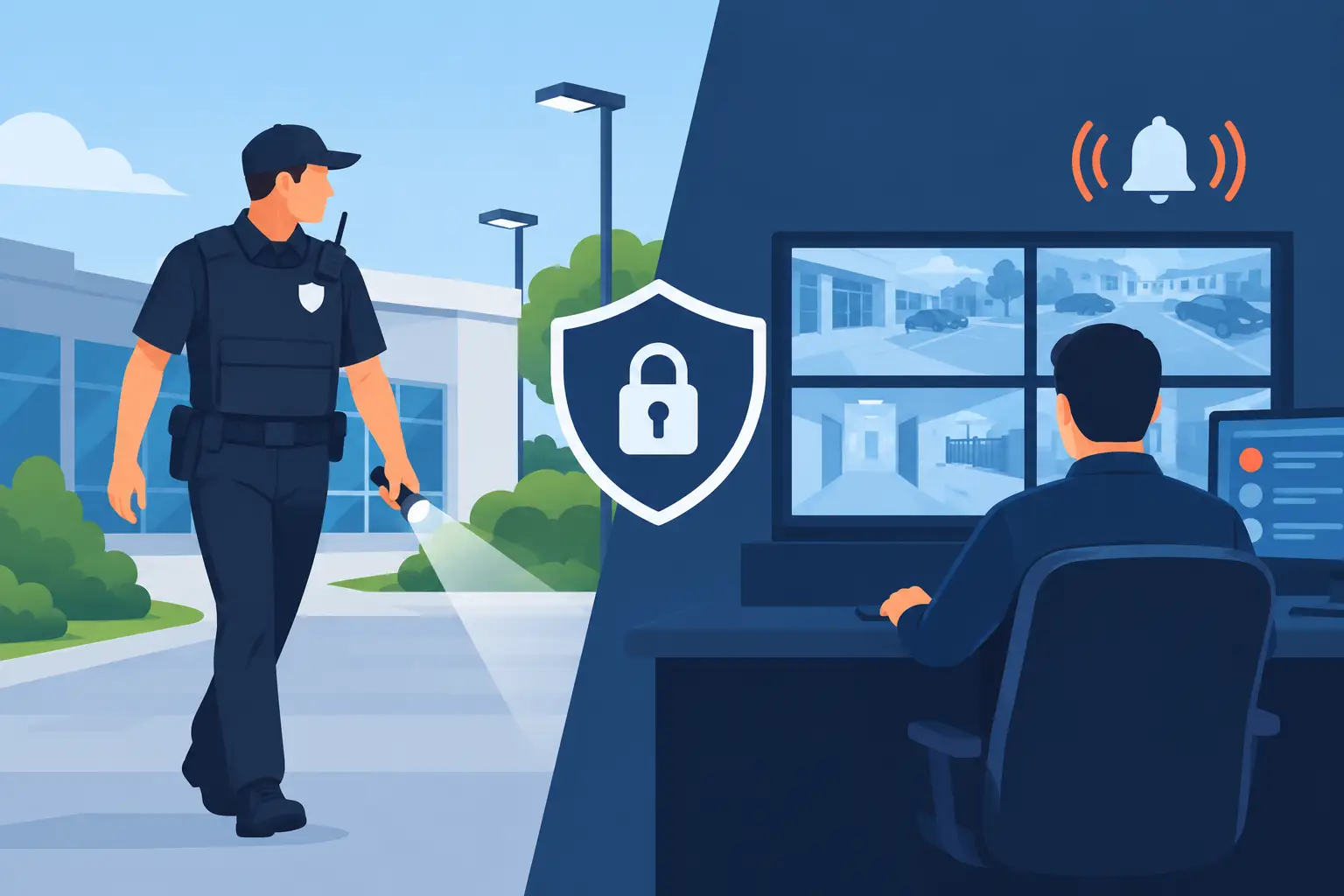
There is also a middle ground that many businesses overlook. A layered model can place unarmed officers at public-facing points while assigning armed supervisors, vehicle patrol, or rapid response units to support the site. That approach can reduce unnecessary friction while still addressing real risk. For many properties, the answer is not armed everywhere. It is armed where the threat analysis supports it.
Risk assessment should drive the decision
The strongest armed security programs begin before a post is staffed. They begin with assessment.
A business should review incident history, neighborhood crime patterns, hours of operation, cash handling practices, access vulnerabilities, employee concerns, prior threats, and the criticality of the site. A facility with repeated after-hours break-ins, weak perimeter control, and slow police response has a different profile than a professional office park with daytime traffic and limited public access.
Decision-makers should also evaluate whether existing controls are doing their job. Sometimes the real issue is poor lighting, inconsistent visitor management, failed badge protocols, or no emergency procedures. Armed guards should not be used to compensate for preventable weaknesses that can be fixed at lower cost and lower complexity.
At the same time, there are cases where better procedures alone are not enough. A site handling controlled substances, expensive inventory, sensitive records, or politically charged public interactions may require both hardened procedures and armed protection. The point is to match resources to actual risk, not to treat every security concern as the same problem.
Liability, training, and public perception matter
An armed guard program brings serious responsibility. That means licensing, use-of-force standards, post orders, reporting protocols, supervision, and scenario-based training all matter. Businesses should expect clear standards for weapons qualification, de-escalation, judgment under stress, and coordination with law enforcement and site leadership.
Liability should be part of the discussion from the start. An armed officer can deter violent crime and provide a higher level of response capability, but that benefit only holds if the provider is disciplined, properly insured, and operationally mature. Poor screening, weak supervision, or vague post expectations create risk that no business needs.
Public perception also matters, particularly in retail, hospitality, healthcare, and event settings. A visible firearm can reassure some people and unsettle others. That does not mean armed coverage is wrong. It means deployment should be thoughtful. Uniform style, officer demeanor, post placement, and communication with site stakeholders all shape how the presence is received.
This is where an experienced provider adds value. The goal is not to make a location feel under siege. It is to protect people and operations without disrupting the environment more than necessary.
Industries and scenarios where armed coverage is often justified
Some businesses ask the question only after a major incident. A better time is before one occurs.
Armed guards are often justified for banks, credit unions, cannabis operations, high-value retail, pharmaceutical sites, critical infrastructure, transportation and logistics yards, executive protection details, and some healthcare environments with recurring violence concerns. They may also make sense during one-time high-risk situations such as cash-intensive events, contentious personnel actions, facility closures, or threat-driven temporary deployments.
For multi-site organizations, the answer may differ by location. One branch may need armed patrol after repeated violent incidents, while another only needs unarmed lobby coverage and better access control. A uniform security plan across every property is easy to manage on paper, but it is not always the most effective or defensible approach.
Making the right call for your business
If you are deciding whether armed guards are necessary, start by defining the threat you are trying to solve. Is the issue nuisance behavior, theft, aggressive trespassing, targeted threats, or credible concern about armed violence? The clearer the problem statement, the better the solution.
Then look at consequences. What happens if the next incident is worse than the last one? Could staff be trapped, customers harmed, inventory taken by force, or operations shut down? Those are business continuity questions as much as security questions.
Finally, consider whether your current posture can actually manage the highest-consequence scenario you face. If it cannot, and if the risk is real rather than hypothetical, armed coverage may be justified. A disciplined provider like Springfield Private Security will approach that decision with assessment first, then staffing recommendations that fit the site rather than overselling the strongest visible option.
The best security posture is rarely the most dramatic one. It is the one that matches your risk, protects your people, and lets your operation keep moving with confidence.

2 Responses